Landscape & Outdoor Lighting in West Palm Beach, FL
A house that looks ordinary at noon can look like a different property at eight in the evening. Uplights under the palms, a lit path to the front door, soft light washing the façade, and the yard stops disappearing at sunset. Nassif Electric has wired South Florida properties since 1976. We design and install landscape and outdoor lighting systems, from a few uplights to a whole property with a dock, and we handle the electrical side that the low-voltage fixtures depend on. We are a Florida statewide licensed unlimited electrical contractor, License EC13001410, licensed, insured and bonded. Call 561-582-2600 for a free outdoor lighting design and a written quote.

What We Light
Uplighting for trees and palms
Palms are the reason most people in this area call. A well-aimed uplight turns a royal palm into the best feature on the property after dark, and the same technique works on oaks, bougainvillea and anything with structure worth seeing. Beam angle and fixture placement do most of the work here. Too wide and the light spills onto the neighbor, too close and you light the trunk and lose the canopy.
Path and walkway lighting
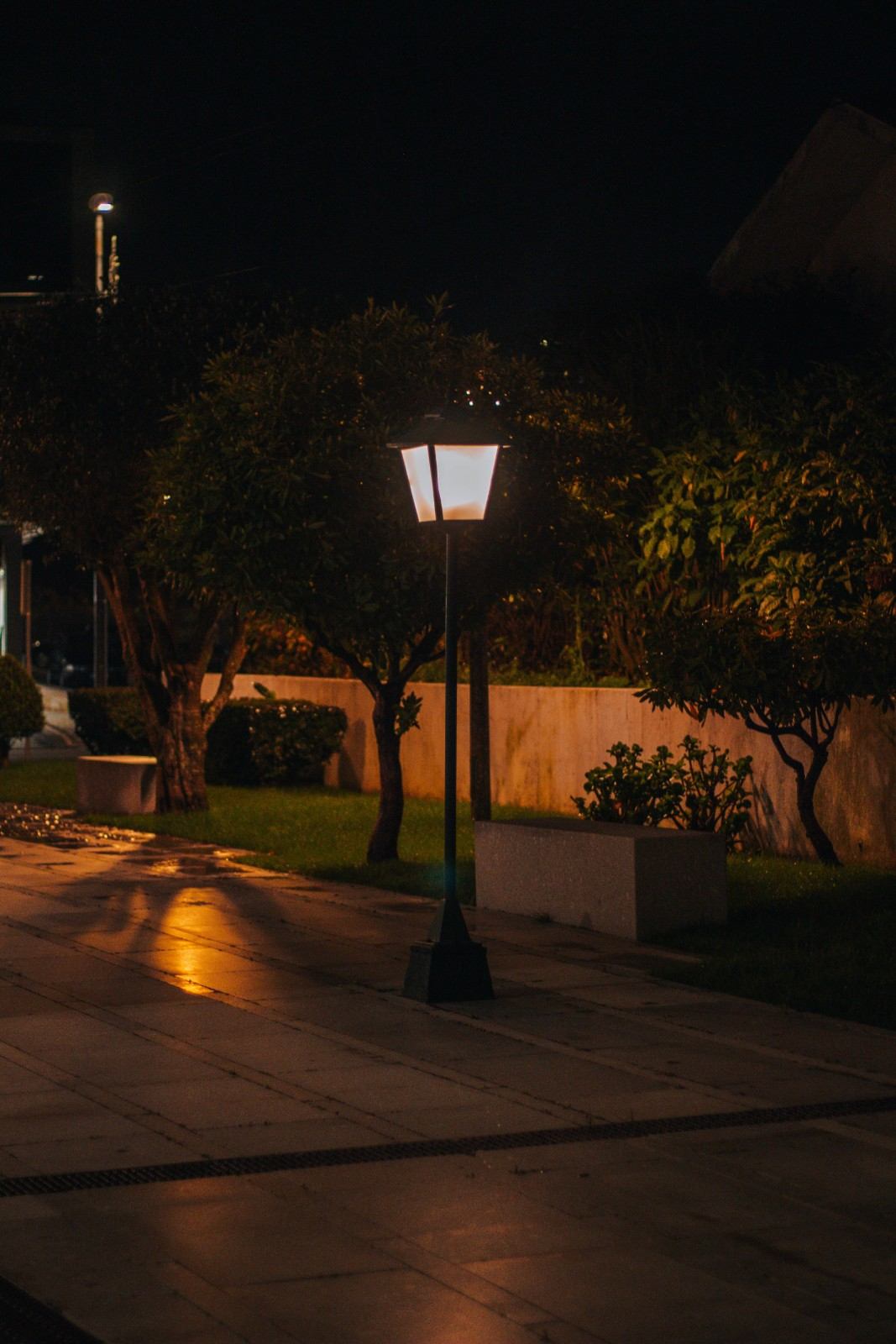
Driveways, front walks, garden paths and steps. The common mistake is a row of identical fixtures at even spacing, which reads as an airport runway. We stagger them, light the turns and the changes in level, and leave the straight stretches darker so the lit parts mean something.
Façade and architectural lighting
Washing the front of the house, lighting columns, entries and rooflines, grazing a textured wall. This is what makes a property look finished from the street, and it is usually the part that sells the whole project to a homeowner who was only thinking about the walkway.
Pool, patio and pool cage lighting
Pool deck lighting, screen enclosure and cage lighting, patio and pergola lighting, outdoor kitchen and bar lighting. Everything near water has its own code requirements for clearances and ground-fault protection, which we cover further down.
Hardscape and step lighting
Lights built into retaining walls, seat walls, steps and paver edges. These fixtures are mostly invisible by day and do a lot of work at night, particularly on steps where a missed edge is a real fall.Lights built into retaining walls, seat walls, steps and paver edges. These fixtures are mostly invisible by day and do a lot of work at night, particularly on steps where a missed edge is a real fall.
Dock, seawall and waterfront lighting
Dock lights, piling and seawall lighting, and lighting for boat lifts. Waterfront wiring in salt air is its own discipline, and the shock hazard around docks is the reason the code treats them differently from a back yard. If you have water behind the house, this is not the place to save money on fixtures or on who installs them.
Security and motion lighting
Floodlights, motion-sensing fixtures, gate and entry lighting, and lighting for the dark corners of a property that a camera cannot see into. Security lighting works best when it is aimed and timed properly rather than simply made brighter, because a bright light in the wrong place creates shadows for someone to stand in.
Repairs and maintenance on existing systems
We service systems other companies installed. Dead zones, a transformer that trips, fixtures full of water, buried connections that corroded through, timers that drift, and LED retrofits for old halogen systems that are eating electricity. Most of what we see is one of four things: a failed connection, a corroded fixture, an undersized transformer, or wire that was buried too shallow and met a shovel.
How a Low Voltage Landscape Lighting System Works
Almost all residential outdoor lighting runs at 12 volts rather than 120. A transformer mounted near the house steps the power down, and the fixtures run off it through buried cable. Low voltage is safer around people, pets, pools and sprinkler heads, and the cable does not need to be in conduit the way line-voltage wiring does.
What decides whether the system still works in five years:
- Transformer sizing. The transformer has to carry the total fixture load with headroom left for the lights you add later, which almost everyone does.
- Wire gauge and run length. Voltage drops over distance. A long run on thin wire means the fixtures at the far end are visibly dimmer, and that is the single most common complaint we hear about systems installed by somebody else.
- Connections. Buried splices that are not properly sealed will corrode in this climate. We use waterproof connectors and keep connections accessible where we can.
- Fixture material. Brass and copper survive salt air and go on working for decades, developing a patina. Painted aluminum does reasonably well inland. Plastic fixtures from a big-box store are a two or three year purchase near the coast, and less than that on the water.
- Control. A photocell, an astronomical timer or a smart controller so the lights follow sunset through the year instead of needing to be reset every few weeks.
The one part of the system that is not low voltage is the circuit feeding the transformer. That is a 120-volt outdoor circuit with GFCI protection, in a weatherproof enclosure, and it is electrical work.

Landscape Lighting Cost in West Palm Beach
|
Job |
Typical range* |
|---|---|
|
Per fixture installed, within an existing system |
$150 to $350 |
|
Starter system: transformer, timer, 6 to 8 fixtures |
$1,500 to $3,000 |
|
Typical system: transformer, 8 to 12 fixtures |
$2,000 to $5,000+ |
|
Larger property, 20+ fixtures, multiple zones |
$5,000 to $12,000+ |
|
Dedicated 120V GFCI circuit for the transformer |
$300 to $800 |
|
Dock and waterfront lighting |
Quoted per property |
|
Repair or rework of an existing system |
Quoted after a site visit |
|
Annual maintenance and re-aiming |
Quoted per system |
*Planning estimates. Your price depends on fixture choice, distances, how much of the property gets lit and what is already in the ground. Written quote before any work starts.
For comparison, national estimates for a professionally installed system run roughly $2,000 to $4,500 with an average near $3,250, and the per-fixture figures published for Florida properties tend to sit below the national average. Nothing here freezes and most of our soil is sand, so trenching is faster and cheaper than it is up north.
What moves your number:
- How many fixtures, and how far they are from the transformer.
- Fixture material. Solid brass costs more up front and is the right call on the water.
- Whether a new outdoor circuit is needed, or the panel is already full.
- Obstacles between the transformer and the fixtures: driveways, pool decks, patios and mature root systems.
- Controls, zoning and whether you want app control or a simple timer.
- Whether we are working around an existing irrigation system, which in this area we almost always are.
Lighting a Property in South Florida
Outdoor lighting here has to survive conditions that most of the country does not have.
Salt air corrodes. Within a few blocks of the Intracoastal or the ocean, fixture material decides the lifespan of the system more than anything else. Brass and copper last. Cheap metal does not, and it fails from the inside where you cannot see it coming.
Storm season is the other factor. Fixtures and transformers have to be mounted and sealed with wind and water driven sideways in mind, and anything near the water needs to survive a surge. After a serious storm, a system that was installed properly needs re-aiming and a quick inspection. A system that was not usually needs rebuilding.
Then there is the sprinkler system. Almost every property here has one, and irrigation and lighting end up sharing the same few inches of ground. Trenching without knowing where the lines run is how a lighting job turns into an irrigation repair. We locate before we dig.
Insects and heat matter too. Warm white LEDs attract fewer insects than the old halogen fixtures, which is why a conversion is worth doing on an older system, and they put out almost no heat near plantings.
Permits, Code and Who Can Do What
The part most homeowners do not expect: outdoor lighting is two jobs, and only one of them is low voltage.
The 12-volt side past the transformer is the fixtures, the buried cable and the connections. The other side is the 120-volt circuit that feeds the transformer, the weatherproof outlet or enclosure it plugs into, and the GFCI protection on that circuit. That part is line-voltage electrical work, and it typically requires a permit and inspection. It is also the reason a page of search results for landscape lighting is full of landscapers, garden centers and irrigation companies: plenty of firms will install the pretty part, and then need somebody else for the circuit, or leave the system running off an extension cord and an existing outlet that was never meant to carry it.
Near water there are specific requirements that are worth knowing about. Pools and spas have required clearances and bonding rules for anything electrical nearby. Docks and boat lifts have their own ground-fault protection requirements, written into the code because of a documented drowning hazard from stray current in the water around energized docks. This is the part of outdoor lighting where the work being done correctly is not a question of appearance.
We pull permits where they are required, and the whole system gets built to code either way.
Does Outdoor Lighting Add Value?
Two kinds of value, and they are not the same.
Resale and curb appeal is the one people mean. A lit property photographs well, shows well in the evening, and looks cared for. Real estate listings in this market use twilight photography for a reason.
The daily one is that you use the outside of the house more. In a climate where the evening is the good part of the day for eight months of the year, a dark patio and a dark pool deck are square footage you paid for and stopped using at sunset. There is also a security argument, though it depends on the lighting being aimed properly rather than merely bright.

Why West Palm Beach Homeowners Call Nassif Electric
- Fifty years in South Florida, since 1976, residential through commercial.
- Florida statewide licensed unlimited electrical contractor, License EC13001410.
- Licensed, insured and bonded.
- We do both halves of the job: the low-voltage system and the 120-volt circuit, transformer and GFCI protection behind it.
- We design on site, at night where it helps, because aiming a fixture is something you judge in the dark.
- We service and repair systems other companies installed.
- 24/7 emergency response for electrical problems.

Areas We Serve
We install landscape and outdoor lighting throughout West Palm Beach, including downtown, Northwood, El Cid, Flamingo Park, SoSo and the neighborhoods along Okeechobee Boulevard, and across South Florida from Juno Beach to Fort Lauderdale: Palm Beach, Palm Beach Gardens, North Palm Beach, Jupiter, Riviera Beach, Lake Worth Beach, Greenacres, Wellington, Royal Palm Beach, Boynton Beach, Delray Beach and Boca Raton.
Frequently Asked Questions
-
How much does landscape lighting cost in West Palm Beach?
Installed fixtures generally run $150 to $350 each within an existing system. A typical residential system with a transformer and 8 to 12 fixtures runs about $2,000 to $5,000, and a starter package of six to eight lights starts around $1,500. Larger properties with multiple zones run higher. Fixture material and distance from the transformer are the biggest variables.
-
Do you need an electrician to install landscape lighting?
For the low-voltage part, past the transformer, not necessarily. For the circuit that feeds the transformer, yes. That is a 120-volt outdoor circuit with GFCI protection and a weatherproof enclosure, which is electrical work and usually requires a permit. We do both halves, which is why nothing in the system ends up running off an extension cord.
-
Do I need a license to install landscape lighting?
Requirements depend on exactly what the work involves and on local permitting, so it is worth asking any contractor directly what they are licensed to do. The clear line is that the 120-volt wiring, the outdoor outlet and the GFCI protection are electrical work. If a company installing your lights cannot do that part, ask who will.
-
Is it difficult to install landscape lighting?
Pushing a few path lights into the ground and plugging in a transformer is easy. Building a system that still looks right in five years is harder, and the parts that go wrong are the ones you cannot see: transformer sizing, voltage drop over long runs, connections that corrode underground, trenching through an irrigation line, and fixtures that cannot survive salt air. Aiming is its own skill, and it has to be done after dark.
-
What are the different types of outdoor lighting?
The main ones are uplighting for trees, palms and architecture; path and step lighting for walkways; downlighting or moonlighting, mounted high and aimed down through branches; wall washing and grazing for façades and textured surfaces; hardscape lighting built into walls and steps; and security or flood lighting. Most properties use three or four of these together rather than one everywhere.
-
Does landscape lighting add value?
It improves curb appeal and shows well in the evening, which matters in this market, and it makes the outside of the house usable after dark for most of the year. Whether it returns its cost at resale depends on the property and the quality of the installation, so treat it as something you buy for the years you live there.
-
How long does a landscape lighting system last?
A professionally installed brass or copper system with quality LED fixtures can run 15 to 20 years or more, with occasional lamp replacement, re-aiming and the odd connection repair. Plastic fixtures from a home center near the coast are a two to three year purchase, and less than that on the water.
-
Can you repair the system another company installed?
Yes, and it is a large part of what we do in this category. Dead sections, transformers that trip, waterlogged fixtures, corroded connections and timers that drift are all common. We look at the whole system first, because fixing one symptom on an undersized transformer or an overlong wire run just moves the problem.
-
Why are some of my lights dimmer than others?
Almost always voltage drop. The fixtures furthest from the transformer, on a long run or thin wire, get less voltage than the ones close in. It can be corrected with a different tap on the transformer, a heavier gauge wire, or splitting the run into zones. Corroded connections cause the same symptom.
-
Can I convert my old halogen system to LED?
Usually yes, and it is one of the better upgrades available. LEDs use a fraction of the power, which often means the existing transformer can carry many more fixtures, they run cool near plantings, and warm white attracts fewer insects than halogen. Sometimes the fixtures take a retrofit lamp, sometimes the housings are too corroded to be worth keeping, and we will tell you which after looking.
-
Do you do dock and waterfront lighting?
Yes. Dock lights, piling and seawall lighting, and lighting around boat lifts. Waterfront work needs corrosion-resistant materials and the ground-fault protection the code requires around docks, which exists because of a real shock hazard in the water. It is not a place for shortcuts.
-
Will the lights turn on by themselves?
Yes. A photocell turns them on at dusk, an astronomical timer follows sunset through the year without being reset, and a smart controller adds app control, scenes and separate schedules for different zones. We usually recommend an astronomical timer at minimum, because a basic clock timer drifts out of step with sunset within a few weeks.
-
How long does installation take?
A typical residential system of 8 to 12 fixtures is usually one to two days, including the design walk, trenching, wiring, mounting and the night aiming visit. Larger properties, dock work or a new circuit from the panel add time. We do the aiming after dark, which sometimes means coming back in the evening.
Book an Outdoor Lighting Design
We will walk the property with you, talk about what is worth lighting and what is better left dark, give you a written price, and come back after dark to aim everything properly.
Call 561-582-2600 or email [email protected] to schedule your free outdoor lighting consultation.