
Ceiling Fan Installation in West Palm Beach, FL
In South Florida a ceiling fan is not decoration. It is the thing that lets you set the thermostat a few degrees higher and still be comfortable, which is why almost every room in almost every house here has one, and why a dead fan gets noticed within a day. Nassif Electric has installed and replaced ceiling fans in South Florida homes since 1976, indoors, on lanais, under pool cages and in two-story rooms that need a lift. We handle the support box and the wiring behind the fan as well as the fan itself. We are a Florida statewide licensed unlimited electrical contractor, License EC13001410, licensed, insured and bonded. Call 561-582-2600 for ceiling fan installation, replacement or repair.
What We Install
Replacing an existing fan
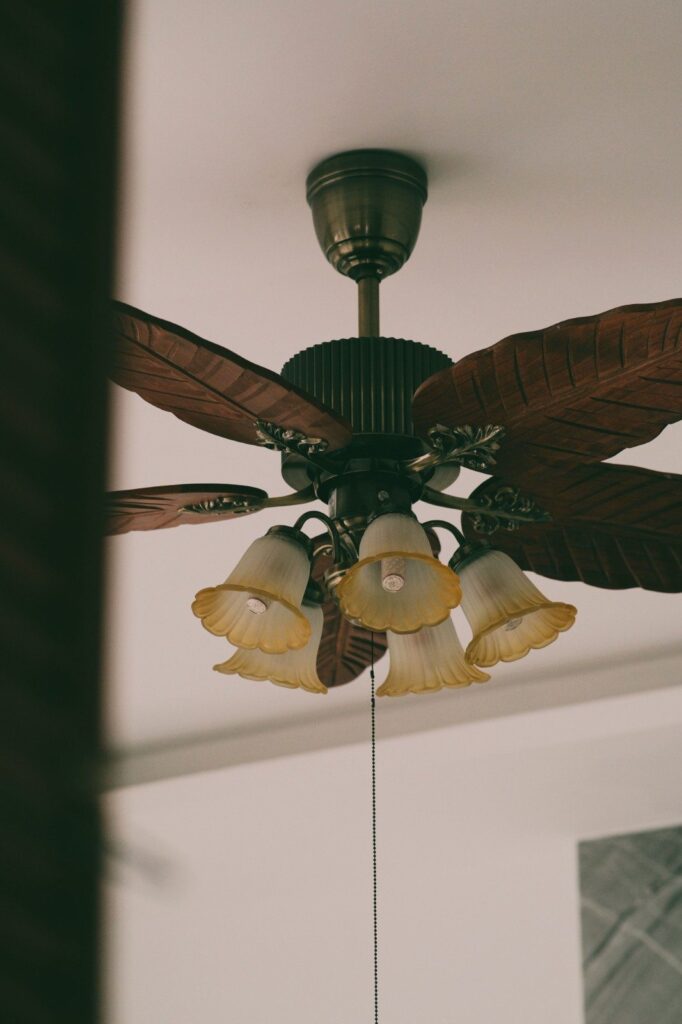
The simplest job, and the most common one. If the existing box is fan-rated and sound, we take the old unit down, check the box and the wiring, and hang the new one. If the box is a light-fixture box that somebody hung a fan on years ago, we replace it, because that is the part that eventually fails.
Replacing a light fixture with a ceiling fan
Also common, and less simple than it looks. A standard light box is designed to hold a few pounds of static weight. A ceiling fan is thirty to fifty pounds that moves continuously for years. The box has to be swapped for a fan-rated one, and if the room is switched for a light only, you may want separate control for the fan and the light, which means either new wiring or a remote or smart control.
Fans in rooms that never had one
New circuit or a tie-in to an existing one, a new box with proper support, and the switching to control it. This is the version where the work above the ceiling decides the price.
Outdoor, lanai and pool cage fans
Covered patios, lanais, screen enclosures and porches. These need damp-rated or wet-rated fans depending on where exactly they hang, and in this climate the rating is not a formality. A standard indoor fan on an open lanai near the water will rust from the inside and the blades will warp. We also deal with the GFCI protection the location requires.
High ceilings and two-story rooms
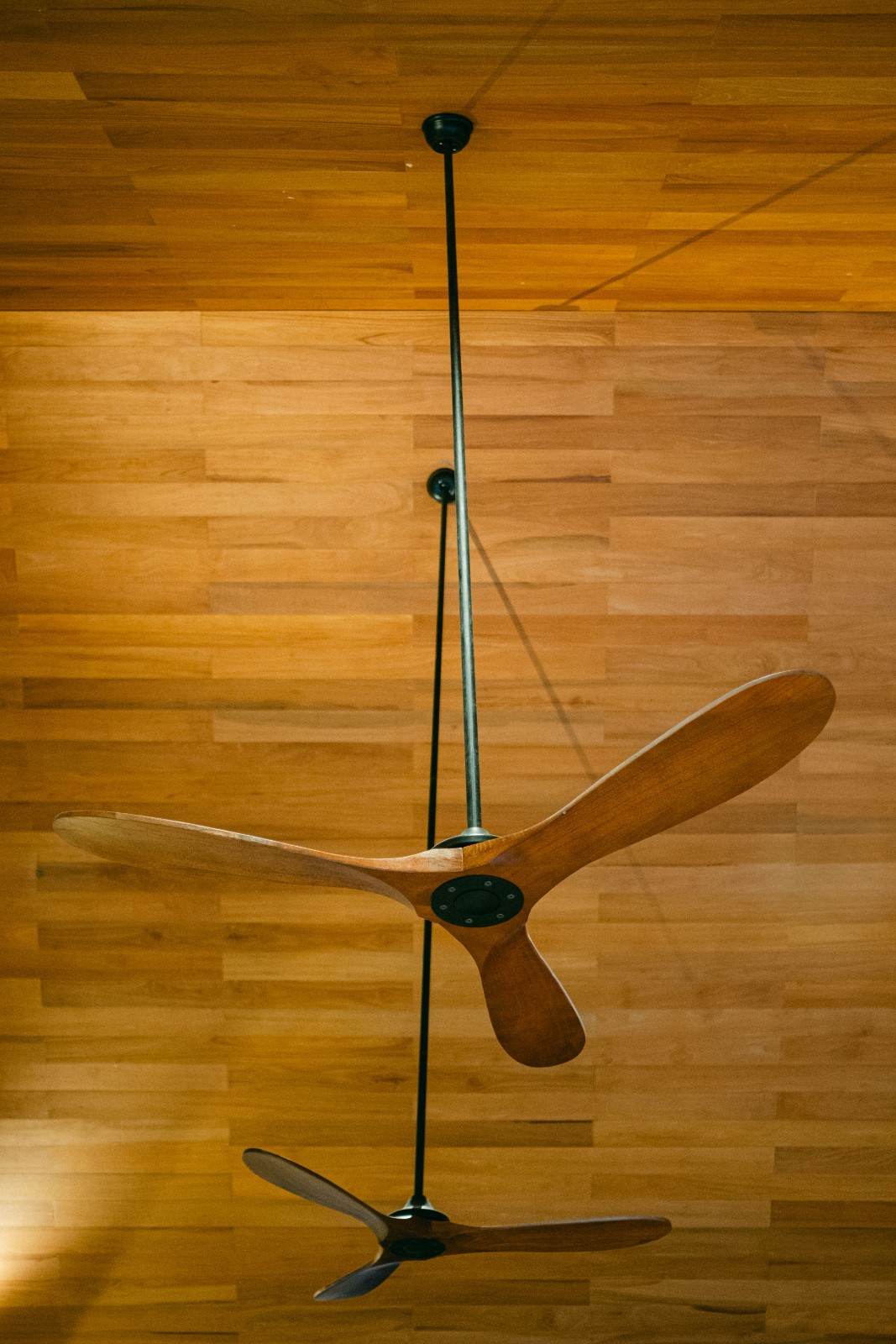
Great rooms, two-story foyers and vaulted ceilings. These need the right downrod length so the fan actually moves air where people are, an angled mount on a sloped ceiling, and lift equipment to do the work safely. It is the job homeowners most often start and then call someone about.
Multiple fans in one visit
Most houses here have four to eight fans, bought at the same time, failing at roughly the same time. Doing them together costs noticeably less per fan than doing them one at a time over two years.
Ceiling fan repair
Fans that wobble, hum, run at one speed, stop responding to the remote, or have a working fan and a dead light. Some of that is a balance or a capacitor problem and some of it is the wiring or the control. We will tell you honestly when a fifteen-year-old fan is worth repairing and when the repair costs more than a better fan.
The Part That Matters: The Box
Almost everything that goes wrong with a ceiling fan installation traces back to what it is hanging from.
A ceiling fan has to be mounted to a box that is listed and marked for ceiling fan support, rated to carry a moving load of about 30 to 50 pounds, and fastened to the structure rather than to the drywall. That means either a box screwed directly to a joist, or an expandable fan brace installed between joists through the opening, which is how it is done when there is no attic access above.
A standard light-fixture box is not that. It is designed for a static load of a few pounds, and plenty of them are plastic. A fan on one of those can hold for years and then come down, usually in the middle of the night and usually with the fan running. We see it often enough that the box is the first thing we check on any fan call, including repair calls where the customer thought the problem was the motor.
Two clearances are worth knowing while you are choosing a fan: blades should sit at least 7 feet above the floor, and at least 30 inches away from the nearest wall or obstruction. On an 8-foot ceiling that usually means a flush or hugger mount. On a 10-foot ceiling or higher, a downrod gets the blades back down into the room where the air does something.
Ceiling Fan Installation Cost in West Palm Beach
|
Job |
Typical range* |
|---|---|
|
Replace a fan on an existing fan-rated box |
$200 to $450 |
|
New fan with a new rated box and switch |
$400 to $900 |
|
Replace a light fixture with a ceiling fan |
$350 to $750 |
|
High ceiling or two-story room (lift required) |
Premium, quoted per job |
|
Outdoor, lanai or pool cage fan |
$350 to $800 |
|
New circuit for a fan where none exists |
$300 to $800 on top of the install |
|
Several fans in one visit |
Lower per fan, quoted together |
|
Repair: balance, capacitor, switch, remote or wiring |
Quoted after diagnosis |
*Planning estimates, excluding the fan itself. Published national figures put professional labor for a straight swap at roughly $100 to $300, rising once new wiring is involved. Our ranges reflect South Florida labor and the fact that a large share of jobs here involve a box that has to be replaced.
What changes the number:
- Whether the existing box is fan-rated, and whether there is attic access above the room.
- Ceiling height, and whether a ladder reaches or a lift is required.
- Sloped or vaulted ceiling, which needs an angled mount and a longer downrod.
- Whether the room is switched for a fan and a light separately, or wired for one switch.
- Remote receivers, smart controls or wall controls instead of a pull chain.
- How many fans are being done on the same visit.

Do You Need an Electrician to Install a Ceiling Fan?
Worth answering plainly, because most of the first page of search results for this is a video telling you to do it yourself.
Swapping a fan onto an existing fan-rated box, with the breaker off and the wiring in good condition, is a reasonable homeowner job and a lot of people do it well. Where it stops being one:
- The existing box is a light box, so a fan-rated box or brace has to go in. This is the most common case and the one most often skipped.
- There is no box, no wiring, or no switch in that spot, so a circuit has to be run.
- The ceiling is high or sloped and the work needs a lift and an angled mount.
- The wiring in the ceiling is old, brittle, aluminum, or has no ground.
- You want separate switching for fan and light, or a smart control.
- It is outdoors, where the fixture rating and GFCI protection both matter.
There is also the handyman question, since handyman services and the big-box referral programs advertise heavily on this. A handyman swapping a fan onto a sound, properly rated box is doing a job within reach. Replacing the box, running a circuit, or touching the panel is licensed electrical work, and in Florida new wiring generally requires a permit and inspection. The honest line is that the fan is the easy part and everything behind it is not.
Why Your Fan Wobbles, Hums or Quit
The four complaints we get, and what is usually behind them.
Wobble. Nine times out of ten this is blade balance or a blade bracket that is slightly bent, and it is fixed with a balancing kit and a few minutes. The other time it is the mounting: a loose box, a box that was never fan-rated, or screws that have worked loose over years of vibration. A wobble that got worse recently is worth looking at rather than living with, because the mounting is the one cause that gets dangerous.
Humming or buzzing. Usually a dimmer or wall control that is not meant for a fan motor, or a failing capacitor. A fan on a light dimmer will hum and will eventually damage the motor.
One speed, or no speed. Typically the capacitor or the pull-chain switch. Both are repairable on a fan worth repairing.
Fan runs, light does not, or the remote stopped working. Often the remote receiver in the canopy rather than the fan itself, which is a cheaper fix than most people expect.
Getting the Fan Right for a Florida Room
A few things that make the difference between a fan you notice and one you forget about.
Size it to the room. A 52-inch fan is the common default, but a small bedroom does better with 42 to 44 inches and a great room needs 60 inches or two fans. An undersized fan in a large room just makes noise.
Get the height right. The blades want to be 8 to 9 feet off the floor for the best airflow, which means a flush mount on an 8-foot ceiling and a downrod on anything taller. A fan tight against a 12-foot ceiling moves air across the ceiling and not across you.
Use the right direction. Counterclockwise in summer pushes air down and creates the breeze that makes a room feel cooler. Clockwise and slow in winter, for the handful of weeks that applies here, pulls air up and moves the warm air off the ceiling without a draft.
Remember what the fan actually saves. A fan cools people, not rooms, so there is no point running one in an empty room. What it buys you is the ability to set the thermostat higher while feeling the same, which Energy Star puts at around 4 degrees. Over a South Florida summer that is a real number on the bill, and it is the reason a working fan in every occupied room is worth the service call.

Why West Palm Beach Homeowners Call Nassif Electric
- Fifty years in South Florida, since 1976.
- Florida statewide licensed unlimited electrical contractor, License EC13001410.
- Licensed, insured and bonded.
- We check and replace the support box rather than hanging a fan on whatever is up there.
- Lift equipment for two-story rooms and vaulted ceilings.
- We install fans you bought anywhere, and we will say up front if one needs a different box, downrod or control.
- Better pricing when several fans are done on the same visit.
- 24/7 emergency response for electrical problems.

Areas We Serve
We install and repair ceiling fans throughout West Palm Beach, including downtown, Northwood, El Cid, Flamingo Park, SoSo and the neighborhoods along Okeechobee Boulevard, and across South Florida from Juno Beach to Fort Lauderdale: Palm Beach, Palm Beach Gardens, North Palm Beach, Jupiter, Riviera Beach, Lake Worth Beach, Greenacres, Wellington, Royal Palm Beach, Boynton Beach, Delray Beach and Boca Raton.
Frequently Asked Questions
-
How much does ceiling fan installation cost?
Replacing a fan on an existing fan-rated box generally runs $200 to $450. A new fan with a new rated box and switch runs $400 to $900, and replacing a light fixture with a fan usually lands between those. High ceilings needing a lift, outdoor locations and new circuits add to it. Those ranges exclude the fan itself.
-
How much does a handyman charge to install a ceiling fan?
Handyman rates for a straight swap are often lower than an electrician's, and for a fan going onto a sound, properly fan-rated box that can be reasonable work. The cost difference usually disappears the moment the box has to be replaced, a circuit has to be run, or the ceiling is high, because that is licensed electrical work and generally permitted work. Ask what happens if the box turns out not to be rated, because that is the most common surprise on these jobs.
-
Do you need a bracket for a ceiling fan? What holds it to the ceiling?
A ceiling fan hangs from an electrical box that is listed and marked for ceiling fan support and rated for a moving load of roughly 30 to 50 pounds, fastened to the structure rather than to drywall. That is either a box screwed to a joist or an expandable fan brace installed between joists, which can be fitted through the ceiling opening when there is no attic above. A standard light-fixture box is not rated for a fan.
-
Can I put a ceiling fan where a light fixture is now?
Usually yes, and it is one of the most common fan jobs. The box almost always has to be changed for a fan-rated one, because a light box is built for a few pounds of static weight. You should also decide whether you want the fan and the light on separate controls, which means either additional wiring or a remote or smart control.
-
Can I install a ceiling fan without wiring?
Not really. A fan needs a supply circuit and a properly rated box. If there is already a ceiling box with power in that spot, the wiring part is largely done. If there is nothing in the ceiling, a circuit has to be run, which is electrical work and generally requires a permit. Battery and plug-in fans exist but they are not a substitute for an installed ceiling fan.
-
Can you install a ceiling fan on a sloped or vaulted ceiling?
Yes. Sloped ceilings need an angled mount adapter when the pitch is steeper than the fan's built-in canopy allows, plus a downrod sized so the blades end up at a useful height. Vaulted and two-story rooms also need lift equipment, which is why this is the install people most often hand over.
-
What size ceiling fan do I need?
Roughly: 42 to 44 inches for a small bedroom or office, 52 inches for a typical bedroom or living room, and 60 inches or two fans for a great room. Blade height matters as much as diameter. Aim for blades 8 to 9 feet off the floor, which means a flush mount on an 8-foot ceiling and a downrod on anything higher.
-
Why does my ceiling fan wobble?
Most wobble is blade balance or a slightly bent blade bracket, corrected with a balancing kit. The other cause is the mounting: a loose box, screws backed out by years of vibration, or a box that was never rated for a fan. If the wobble is new or getting worse, have it looked at, because the mounting causes are the ones that matter.
-
Why does my ceiling fan hum?
Usually a wall control or dimmer that is not designed for a fan motor, or a failing capacitor. A fan on a light dimmer will hum and will eventually damage the motor. A fan-rated control solves most of these.
-
My fan works but the light does not, or the remote stopped responding. What is it?
Often the remote receiver tucked in the canopy rather than the fan itself, and that is a straightforward replacement. It can also be the pull-chain switch or the wiring in the canopy. Either way it is usually cheaper than a new fan.
-
Can you fix a fan you did not install?
Yes. We repair and service fans regardless of who installed them, including balance problems, capacitors, switches, remote receivers and the wiring and box behind the fan. We will also tell you when a fan is not worth repairing rather than selling you a repair that costs most of a replacement.
-
Do I need a special fan for my patio or pool cage?
Yes. Covered porches and lanais need at least a damp-rated fan, and anywhere exposed to blowing rain or spray needs a wet-rated one. Near the water, salt air is the deciding factor: an indoor-rated fan outdoors here corrodes from the inside and the blades warp. The location also has its own GFCI requirements.
-
Which direction should my ceiling fan turn?
Counterclockwise in summer, so the blades push air down and create the breeze that makes you feel cooler. Clockwise and on low in winter, which pulls air upward and moves warm air off the ceiling without a draft. In this climate you will spend most of the year in the summer setting.
-
Does a ceiling fan actually lower my electric bill?
Indirectly. A fan cools people rather than rooms, so running one in an empty room costs money and saves nothing. What it does is let you raise the thermostat while feeling just as comfortable, which Energy Star puts at about 4 degrees. Over a Florida summer that is a meaningful difference, which is why working fans in the rooms you use are worth keeping in service.
Book a Ceiling Fan Installation
One fan, a lanai full of them, or a house where every fan is the same age and failing in sequence. We will check what is holding them up, replace what needs replacing, and give you a price before we start.
Call 561-582-2600 or email [email protected] to schedule ceiling fan installation or repair.